
High-Risk Payment Gateways for Shopify Payments
By HighRiskPay Editorial Team · Updated 2026-08-20
High-risk payment gateway integration requires platform-specific API credentials: Shopify uses custom app checkout extensions, WooCommerce relies on the official payment gateway plugin architecture, and Magento 2 needs M2 module configuration through the
Integration requires a dedicated high-risk merchant account. Shopify Payments excludes prohibited categories despite the platform powering over $100 billion in sales. WooCommerce and Magento lack built-in processors entirely. Merchants must connect third-party high-risk gateways via API or plugin for approval and PCI-compliant checkout.
High-risk payment gateway integration for Shopify, WooCommerce, and Magento requires acquiring banks that support restricted categories. Shopify Payments excludes most high-risk verticals. HighRiskPay structures dedicated merchant accounts through high-risk-friendly acquirers, delivering e-commerce high risk payment processing built for hosted checkout, API connections, and native plugins across all three platforms — including full magento high risk payment integration — with settlement cycles of 1–3 business days.
Understanding High-Risk Payment Gateway Challenges
- Shopify Payments excludes most high-risk merchants due to prohibited business categories varying by country.
- Shopify powers over $100 billion in annual sales across millions of online stores globally.
- High-risk merchants require specialized payment processors that integrate seamlessly with WooCommerce and Magento platforms.
- Financial institutions classify businesses as high-risk, complicating payment gateway selection for affected merchants.
What Do You Need Before Gateway Integration?
Preparation determines integration success. Merchants entering high-risk verticals need three things ready before connecting a gateway: eligibility documentation, a compatible platform build, and a compliant acquiring path. Skipping any one of these steps stalls onboarding and delays revenue.
Standard payment providers are typically not built to manage elevated risk. That gap leads directly to rejections, frozen funds, and abrupt account restrictions for merchants operating outside conventional risk tolerances. Shopify payments, for example, only supports low-risk industries, so merchants selling CBD, nutraceuticals, firearms, or adult products must arrange a third-party gateway before launch, not after.
What information does a high-risk gateway setup require?
A clean business review comes first. Underwriters assess eligibility, transaction history, and industry classification before any risk assessment or acquiring alignment begins. Only after that alignment does merchant account and gateway setup move forward.
Does the platform matter for integration?
Platform choice shapes technical readiness. Dedicated merchant IDs pair with advanced payment gateway integrations across major ecommerce systems, including:
- Shopify stores requiring a third-party checkout replacement
- A high risk merchant account woocommerce setup through supported payment plugins
- Magento gateway builds needing server-to-server or hosted checkout configuration, paired with a high risk payment gateway plugin where available
Merchants who confirm platform compatibility early avoid rebuilding checkout flows mid-launch.
How Do You Integrate Shopify, WooCommerce, and Magento?
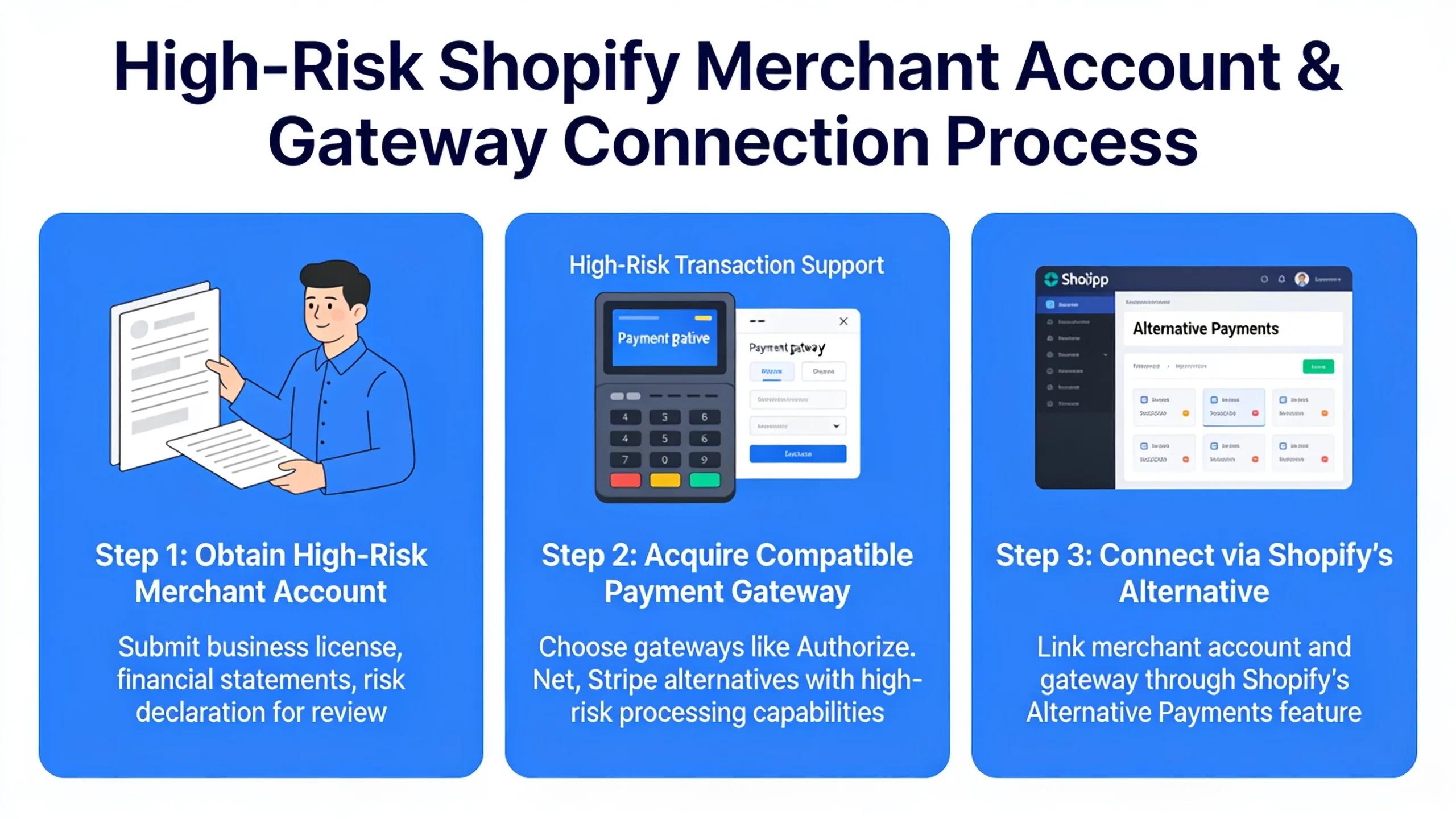
Integration paths differ by platform, but each route ends in a stable connection between store and gateway. High-risk merchants running Shopify obtain a dedicated merchant account. A compatible payment gateway, then link the two through Shopify’s Alternative Payment Provider settings. Since Shopify’s native checkout excludes most regulated categories, this workaround remains standard practice for adult, CBD, nutraceutical, and firearms sellers.
How does WooCommerce integration work for high-risk stores?
WooCommerce ships without a built-in processor. Store owners select their own gateway. Connect it manually through the plugin dashboard, giving operations teams full control over provider choice. This flexibility works in a merchant’s favor: a WooCommerce integration can be swapped or reconfigured without waiting on platform-level approval.
What does the setup process look like across platforms?
- Confirm eligibility and complete business review for the merchant account.
- Select a compatible gateway supporting hosted checkout or server-to-server API connections.
- Connect the gateway to Shopify, WooCommerce, or Magento using platform-specific settings or plugins.
- Test transactions across currencies before launch.
- Go live with monitoring in place.
HighRiskPay supports each of these platforms with dedicated merchant IDs. Gateway integrations built for hosted checkout and direct API deployment. Technical directors managing Magento builds gain the same infrastructure options as Shopify or WooCommerce operators.
| Platform | Native Payment Support | Integration Method |
|---|---|---|
| Shopify | Restricted for high-risk categories | Alternative Payment Provider settings |
| WooCommerce | None built-in | Plugin-based gateway connection |
| Magento | Limited for regulated goods | API or extension-based integration |
Every connection includes multi-currency and cross-border processing, with settlement cycles of one to three business days confirmed during testing. Any store goes live.
How Do You Troubleshoot Integration and Avoid Failures?
Failed integrations trace back to one root cause: standard payment infrastructure assumes predictable, low-risk transaction patterns. High-risk merchants running Shopify payments alternatives, a WooCommerce integration, or a Magento checkout operate outside those assumptions, which triggers holds, declines, and account freezes.
Why does a payment gateway suddenly stop working?
Most disruptions happen because a single acquiring bank cannot absorb the merchant’s risk profile alone. A network spanning more than 10 onshore and offshore acquiring banks spreads that exposure. One acquirer’s policy shift does not shut down processing entirely.
Store owners troubleshooting recurring failures should follow this sequence:
- Confirm the merchant account matches the business’s actual industry classification.
- Verify real-time transaction monitoring and fraud screening tools are active on the gateway.
- Check that dispute and chargeback alerts are configured before transaction volume scales.
- Review processing limits quarterly, since risk-aware structuring is designed to raise them over time.
Consistent monitoring, not one-time setup, keeps integrations stable long term.
FAQ
Why can’t high-risk merchants use Shopify Payments?
Shopify Payments excludes prohibited business categories like CBD, nutraceuticals, firearms, and adult products, so these merchants need a dedicated high-risk merchant account and third-party gateway connected through Shopify’s Alternative Payment Provider settings.
What do merchants need before integrating a high-risk gateway?
Merchants need eligibility documentation, a compatible platform build, and a compliant acquiring path. Underwriters review business history and industry classification before merchant account and gateway setup proceeds.
How does integration differ across Shopify, WooCommerce, and Magento?
Shopify requires linking a dedicated merchant account through Alternative Payment Provider settings. WooCommerce and Magento lack built-in processors entirely, requiring third-party gateways connected via supported plugins, API, or hosted checkout configuration.
Conclusion
In closing, integrating a high-risk payment gateway across Shopify, WooCommerce, Magento, and other major platforms requires deliberate attention to compliance, fraud prevention, and merchant account alignment. HighRiskPay delivers the specialized infrastructure, risk tools, and acquiring bank partnerships necessary to establish reliable payment processing for regulated and high-risk industries. By selecting a gateway provider with proven expertise in your sector and implementing robust monitoring protocols, you secure both immediate transaction stability and sustainable long-term growth across global markets.