
Onshore Acquirers vs Offshore: High-Risk Merchant Accounts
By HighRiskPay Editorial Team · Updated 2026-08-30
Choosing between onshore vs offshore acquirers is one of the most consequential decisions in high risk payment acquiring. A domestic merchant account high risk business sets up onshore keeps processing under home-country banking law, while an offshore merchant account high risk business opens abroad often reaches banks more willing to underwrite elevated-risk industries. Weighing onshore acquiring vs offshore acquiring properly is central to high risk payment processing stability: HighRiskPay structures accounts across more than 10 onshore and offshore acquiring banks, diversifying risk and improving approval performance through Offshore High-Risk Accounts: Top Jurisdictions for Company Formation for regulated, high-risk merchants worldwide.
Understanding Onshore vs Offshore Acquirer Models
- Onshore acquirers operate under domestic banking law and offer regulatory stability, while offshore acquirers register in foreign jurisdictions and offer more flexibility for elevated-risk or cross-border business models.
- Offshore is not automatically the “high-risk” option—many merchants choose offshore acquirers for multi-currency flexibility and broader international reach.
- HighRiskPay diversifies risk across a network of more than 10 onshore and offshore acquiring banks, reducing single-acquirer dependency and improving approval rates.
- A sound acquirer comparison weighs settlement speed, compliance alignment, currency reach, and fraud tooling rather than marketing claims alone.
- Spreading volume across multiple acquiring banks protects merchants from processing disruptions if one bank tightens underwriting or exits an industry.
- HighRiskPay’s staged onboarding process—business review, risk assessment, setup, integration, and go-live—gives merchants visibility and reduces surprises after launch.
What Sets Onshore and Offshore Acquirers Apart?
Bank location and regulatory jurisdiction separate an onshore acquirer from an offshore acquirer. An onshore acquirer operates within a merchant’s home country, subject to local banking law and oversight. An offshore acquirer, by contrast, is registered in a foreign jurisdiction, often chosen for its flexibility toward complex or elevated-risk business models.
A high-risk merchant account itself is a dedicated bank account structured for businesses facing greater exposure to chargebacks and fraud. Both onshore and offshore acquirers can issue these accounts, but their appetite for risk differs sharply.
Is offshore automatically the high-risk option?
Not entirely. Some offshore providers cater specifically to categories like gambling or online auctions, but this is not a universal rule. Many offshore acquirers serve businesses seeking multi-currency flexibility or broader international reach, regardless of risk classification.
Finance leads weighing payment infrastructure typically run an acquirer comparison across three factors:
Neither structure guarantees approval on its own. Merchants gain the most stability when acquiring relationships are matched deliberately to industry, transaction volume, and cross-border needs. HighRiskPay partners directly with high-risk-friendly acquiring banks to structure dedicated merchant accounts, detailed further in Dedicated Merchant IDs: Approval Rates & Stability, built for long-term processing stability.
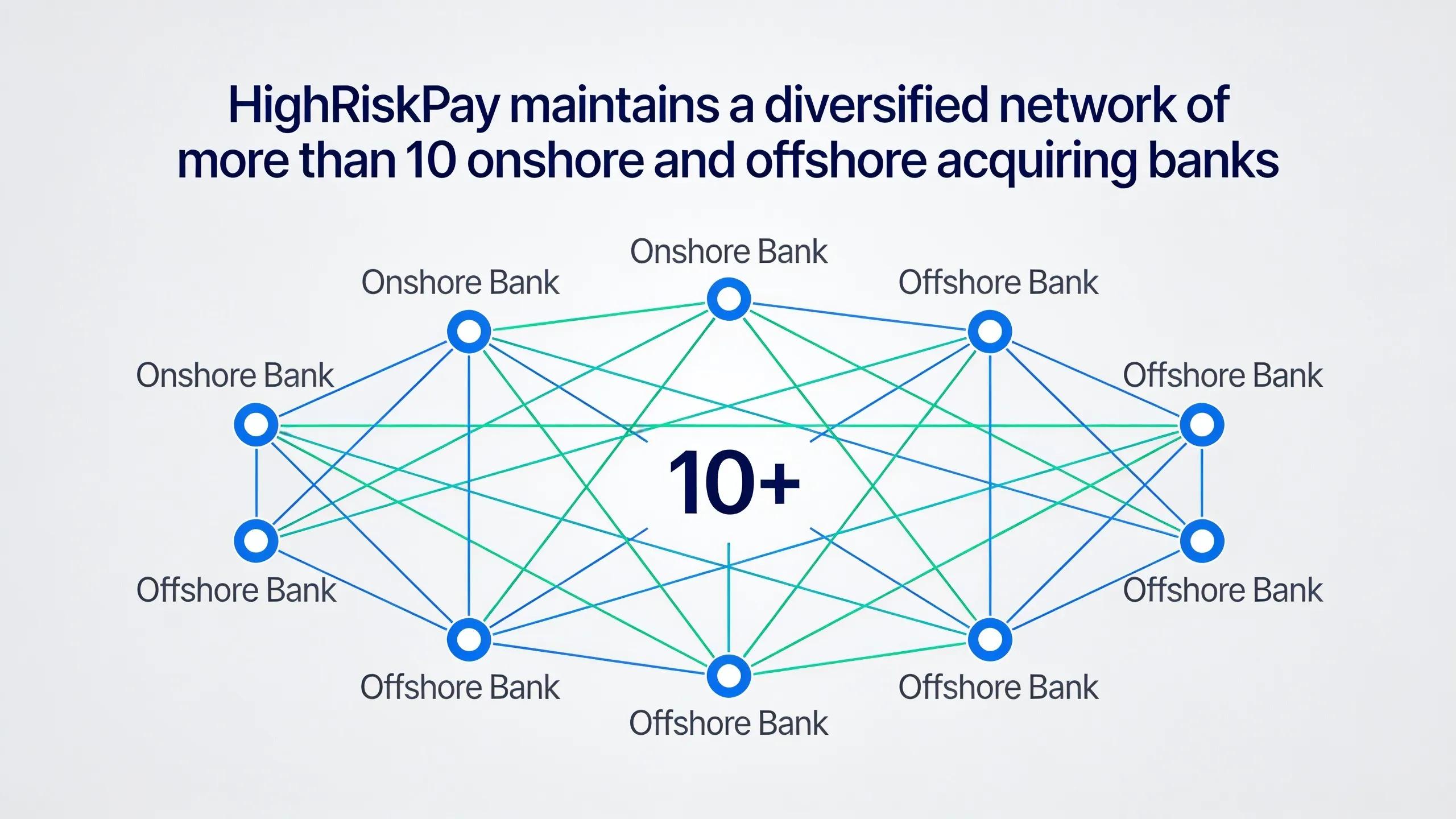
Why Does a Diversified Acquirer Network Matter?
Concentration risk sinks more high-risk merchant accounts than fraud ever does. HighRiskPay maintains a network of more than 10 onshore and offshore acquiring banks, spreading transaction volume across multiple partners instead of relying on one. An onshore acquirer settles payments through banks based in the merchant’s home country, while an offshore acquirer routes transactions through international banking partners built for cross-border models. Running a careful acquirer comparison between the two options lets a merchant match banking relationships to industry risk and target geography.
What Happens When a Merchant Relies on a Single Acquirer?
A single acquiring relationship creates one point of failure. If that bank tightens underwriting or exits an industry, processing stops overnight. Spreading volume across several acquirers reduces this exposure and supports long-term processing continuity, even when individual banking partners shift their risk appetite.
This structure delivers measurable advantages for merchants scaling internationally:
- Improved approval performance across risk-sensitive industries
- Higher processing limits as volume distributes across multiple banking relationships
- Reduced dependency on any single acquiring partner
- Continuity of service during underwriting reviews or policy shifts
Paired with risk-aware onboarding, the 10+ acquirer network helps merchants scale safely across Shopify, WooCommerce, Magento, and BigCommerce storefronts, keeping payment infrastructure stable as sales volume and regional footprint expand.

How Should You Compare Acquirer Options?
Five factors separate a reliable payment partner from a fragile one: settlement speed, compliance alignment, currency reach, fraud tooling, and structural transparency. High-risk merchant accounts exist because certain industries carry elevated chargebacks, fraud exposure, and regulatory scrutiny, which means the stakes of choosing poorly are higher than for a standard retail account. Merchant owners who skip a rigorous acquirer comparison often discover the gap only after a frozen payout or a terminated account disrupts revenue.
A sound comparison starts with concrete operational criteria, not marketing claims.
What Onboarding Process Should an Acquirer Follow?
A dependable provider structures onboarding in defined stages rather than a single approval decision. HighRiskPay moves clients through business review, eligibility and risk assessment, acquiring alignment, account and gateway setup, integration and testing, then go-live with ongoing optimization. That sequence gives finance leads visibility at each stage, reducing surprises after launch.
Merchants comparing an onshore acquirer against an offshore acquirer should weigh this same framework consistently across every candidate before signing.
Onboarding Steps
- Business review: HighRiskPay evaluates the merchant’s business model, industry classification, and processing history
- Risk assessment and acquiring alignment: the account is matched to acquiring banks within the 10+ network best suited to its risk profile
- Account setup: the merchant account is structured and configured for the business’s specific processing needs
- Integration and testing: payment gateways and shopping cart platforms (Shopify, WooCommerce, Magento, BigCommerce) are connected and verified
- Go-live with ongoing optimization: the account moves into live processing with continued monitoring and support
FAQ
What is the main difference between onshore and offshore acquirers?
Onshore acquirers register merchant accounts within the business’s home country under domestic banking law. Offshore acquirers register accounts in a foreign jurisdiction, often offering more flexibility for elevated-risk industries.
Does choosing an offshore acquirer mean a business is automatically high-risk?
No, offshore acquirers are not automatically the high-risk option. Many businesses use offshore providers for multi-currency flexibility or broader international reach, not because of risk classification.
Why does HighRiskPay use a diversified network of onshore and offshore acquirers?
HighRiskPay structures accounts across more than 10 onshore and offshore acquiring banks to spread transaction volume, reduce single-acquirer dependency, and improve approval performance for regulated, high-risk merchants.
Conclusion
Ultimately, the choice between onshore and offshore acquirers comes down to your operational needs, regulatory environment, and growth trajectory. HighRiskPay resolves that complexity with a diversified acquiring network that draws on both structures strategically, so your merchant account stays stable, scalable, and compliant as market conditions and your business evolve. This risk-aware approach does away with the false choice between options, giving your high-risk business the infrastructure and support it needs for sustained processing success.
FAQ
What is the main difference between onshore and offshore acquirers?
The core difference is where the acquiring bank is registered and which banking law it answers to. An onshore acquirer operates within the merchant’s home country, subject to domestic banking regulation and oversight. An offshore acquirer registers in a foreign jurisdiction, which often gives it more flexibility to underwrite complex or elevated-risk business models. Both structures can issue high-risk merchant accounts, but their risk appetite, fee structures, and regulatory frameworks differ. Matching the right structure to a business’s industry, transaction volume, and cross-border needs is what determines long-term processing stability.
Does choosing an offshore acquirer automatically mean a business is high-risk?
No. While some offshore providers focus specifically on categories such as gambling or online auctions, offshore acquiring is not inherently tied to high-risk classification. Many merchants choose offshore acquirers purely for multi-currency flexibility or to reach international customers more efficiently, regardless of how their industry is risk-rated. Risk classification depends on factors like chargeback exposure, industry type, and regulatory scrutiny, not on whether the acquiring bank is domestic or foreign. Businesses should evaluate offshore options on their own merits rather than assuming higher risk by default.
Why does HighRiskPay rely on a diversified network of onshore and offshore acquirers?
Concentration risk is one of the biggest threats to a high-risk merchant account’s stability. By structuring accounts across more than 10 onshore and offshore acquiring banks, HighRiskPay spreads transaction volume instead of depending on a single banking relationship. This diversification improves approval performance, raises processing limits as volume distributes across partners, and protects merchants from sudden disruption if one acquiring bank tightens underwriting or exits an industry. It gives regulated, high-risk businesses continuity of service even as individual banking partners shift their risk appetite.
What fraud prevention tools protect a high-risk merchant account?
A reliable acquirer comparison should confirm that fraud tooling includes real-time transaction monitoring, chargeback alerts, device fingerprinting, and 3D Secure 2.0 authentication. These tools work together to flag suspicious activity before it becomes a costly dispute, which matters more for high-risk merchant accounts because these businesses already face elevated chargeback and fraud exposure compared to standard retail accounts. Combined with PCI-aligned gateways and acquiring banks, this fraud tooling forms part of the operational criteria finance leads should verify rather than relying on marketing claims alone.
How fast can high-risk merchants access settled funds with HighRiskPay?
Settlement speed is one of the concrete factors a high-risk merchant should verify before choosing an acquiring partner, since delayed access to funds can strain cash flow. HighRiskPay offers a settlement cycle of 1 to 3 business days for available funds, giving merchants faster access to revenue than many providers offer for elevated-risk industries. Fast, predictable settlement is especially important for high-risk businesses, where processing disruptions or frozen payouts can otherwise create serious operational and financial pressure.
Which e-commerce platforms work with HighRiskPay’s high-risk merchant accounts?
HighRiskPay’s payment infrastructure connects with major shopping cart platforms including Shopify, WooCommerce, Magento, and BigCommerce. Integration and testing on these platforms is one of the defined stages in HighRiskPay’s onboarding process, ensuring payment gateways are properly connected and verified before an account goes live. This multi-platform compatibility, paired with the 10+ acquirer network, helps merchants scale safely across different storefronts as sales volume and regional footprint expand, without needing to rebuild their payment setup for each platform.
How does HighRiskPay ensure compliance for high-risk merchant accounts?
Compliance alignment is one of the core factors in a sound acquirer comparison, and HighRiskPay addresses it by working through PCI-aligned gateways and acquiring banks. This ensures payment data handling meets recognized security standards, which is especially critical for high-risk merchant accounts facing greater regulatory scrutiny than standard retail businesses. Compliance alignment is verified alongside settlement speed, currency reach, and fraud tooling as part of the operational criteria merchants should check before committing to an acquiring partner, rather than relying on marketing claims alone.