
Pci Dss for Highrisk Merchants: Requirements, Risks & Best Practices
By HighRiskPay Editorial Team · Updated 2026-07-20
PCI DSS compliance requirements, formalized by the PCI Security Standards Council. Updated through guidance such as the January 2019 Best Practices for Maintaining PCI DSS Compliance (Version 2.0), establish 12 core security requirements that organizations handling payment card data must follow to protect cardholder information and reduce breach risks.
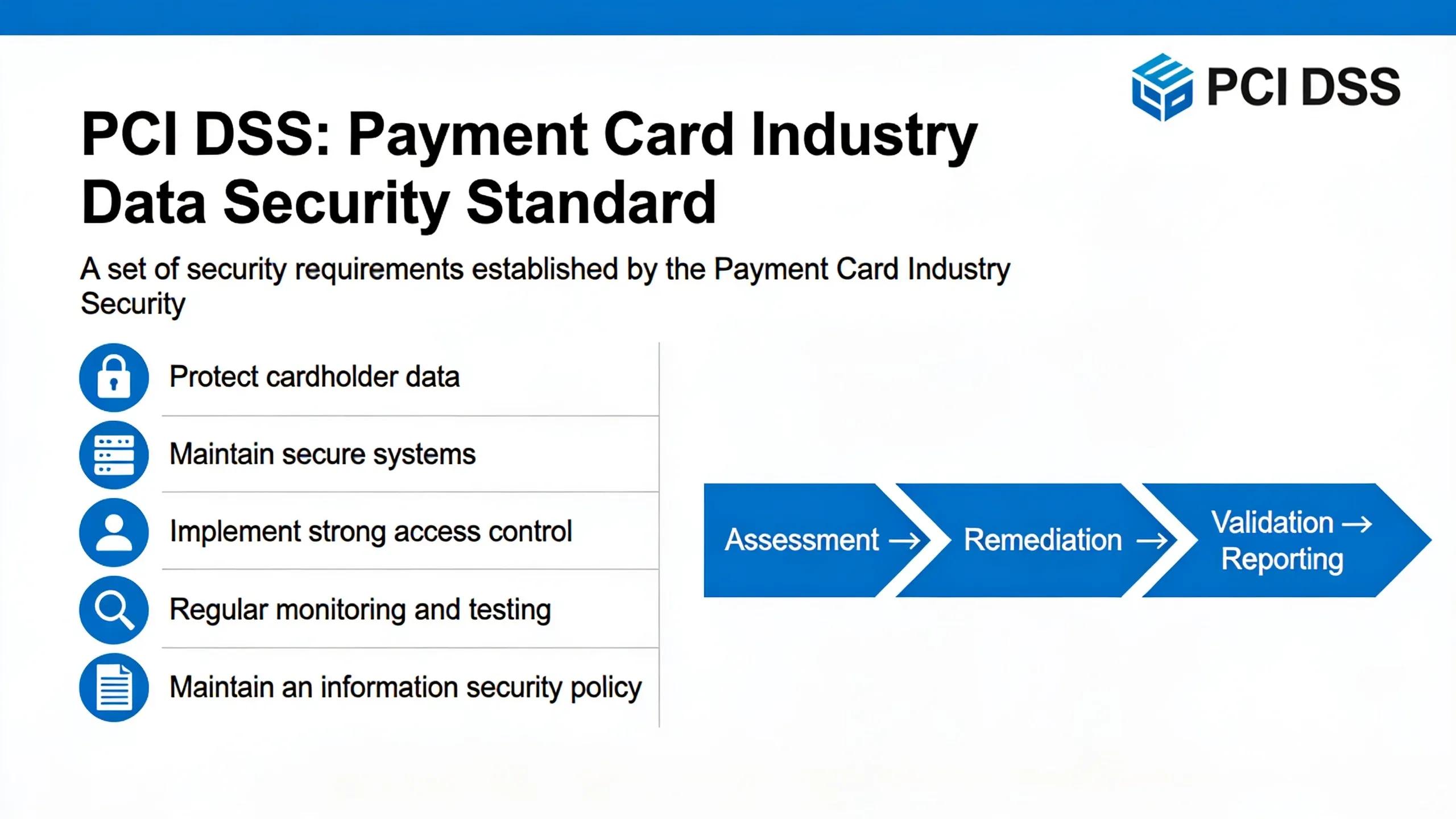
PCI DSS, established by the Payment Card Industry Security Standards Council, defines security requirements for any business handling cardholder data. Core best practices include network segmentation, access controls, encryption, and continuous monitoring. HighRiskPay aligns merchants with compliant gateways and acquiring banks, supporting long-term processing stability across high-risk and regulated industries.
Essential Principles of PCI DSS Compliance
PCI DSS Version 2.0 was established in January 2019 by the Maintaining PCI DSS Compliance Special Interest Group.
Organizations must protect payment data throughout the entire payment lifecycle using industry-driven security standards.
PCI Security Standards Council develops and maintains multiple standards supporting different stakeholders and payment functions.
Compliance management requires adherence to various regulations including SOC, HIPAA, and NIST security frameworks.
PCI DSS Version 2.0 was established in January 2019 by the Maintaining PCI DSS Compliance Special Interest Group.
Organizations must protect payment data throughout the entire payment lifecycle using industry-driven security standards.
PCI Security Standards Council develops and maintains multiple standards supporting different stakeholders and payment functions.
Compliance management requires adherence to various regulations including SOC, HIPAA, and NIST security frameworks.
What Are the 12 Core PCI DSS Requirements?
PCI DSS for high-risk merchants is a structured set of security requirements established by the Payment Card Industry Security Standards Council to protect cardholder data. cite-1 The standard applies to every organization that processes, stores, or transmits payment card information — no exceptions.
The PCI Security Standards Council develops and maintains these requirements to protect payment data across the entire payment lifecycle. cite-2 For high-risk merchants, failing to meet these requirements exposes the business to fines, account termination, and heightened fraud liability.
The 12 requirements are organized into six control objectives:
Install and maintain network security controls
Apply secure configurations to all system components
Protect stored account data
Protect cardholder data with strong cryptography during transmission
Protect all systems against malware
Develop and maintain secure systems and software
Restrict access to system components by business need
Identify users and authenticate access
Restrict physical access to cardholder data
Log and monitor all access to system components
Test security of systems and networks regularly
Support information security with organizational policies and programs
Install and maintain network security controls
Apply secure configurations to all system components
Protect stored account data
Protect cardholder data with strong cryptography during transmission
Protect all systems against malware
Develop and maintain secure systems and software
Restrict access to system components by business need
Identify users and authenticate access
Restrict physical access to cardholder data
Log and monitor all access to system components
Test security of systems and networks regularly
Support information security with organizational policies and programs
Who Does PCI DSS Actually Apply To?
PCI DSS applies to any organization that processes, stores, or transmits payment card data. Including merchants, service providers, and financial institutions. cite-1 High-risk businesses are not exempt simply because of their industry classification.
Why Was PCI DSS Created?
The standard was designed to deter credit card-based fraud and equip merchants. Service providers to prevent and respond to cybersecurity attacks and data breaches. High-risk PCI compliance and robust card data security for high-risk businesses are essential safeguards. They are foundational requirements for maintaining processing continuity.

Why Does PCI Compliance Matter for High-Risk Merchants?
PCI DSS for high-risk merchants is not optional infrastructure — it is the foundation that keeps payment accounts active and revenue flowing. High-risk businesses operating without compliant payment infrastructure routinely face frozen or delayed settlements, sudden account restrictions, and outright account closures that halt processing overnight. cite-3
The stakes extend beyond operational disruption. Data breaches that compromise cardholder data carry significant financial and reputational consequences for merchants and service providers alike. cite-4 For high-risk merchants already operating under elevated acquirer scrutiny, a single security incident accelerates the path to permanent account termination.
What Happens When High-Risk Merchants Ignore PCI Requirements?
Merchants that neglect high-risk PCI compliance expose themselves to a compounding set of risks. Acquirers monitoring high-risk portfolios treat compliance gaps as red flags, often triggering account reviews that result in processing limits, reserve increases, or termination. Recovery from those outcomes is slow and costly.
How Does HighRiskPay Address Card Data Security?
HighRiskPay delivers card data security for high-risk merchants through a Dedicated Merchant IDs: Approval Rates & Stability. Card Data Security service built into its core solutions portfolio. HighRiskPay supports PCI alignment through High-Risk Payment Gateway Integration Guide, pairing that infrastructure with settlement cycles of 1–3 business days. The result is a processing environment structured for both security and stability. Two requirements that high-risk merchants cannot afford to separate.

What Best Practices Sustain Long-Term PCI DSS Compliance?
Sustaining pci dss for highrisk merchants requires layered security controls, continuous monitoring, and a structured post-launch optimization process. Merchants that treat compliance as a one-time event — rather than an ongoing discipline. Expose themselves to data breaches, account terminations, and costly fines.
Which Security Controls Matter Most for High-Risk Merchants?
Highrisk pci compliance depends on deploying the right tools from day one. HighRiskPay’s risk infrastructure includes real-time transaction monitoring, advanced fraud screening, velocity controls, device fingerprinting, rule-based filters, and 3D Secure 2.0. Each layer addresses a distinct attack surface, reducing the likelihood that a single vulnerability compromises card data security highrisk operations.
Key controls that support sustained compliance:
Real-time transaction monitoring — flags anomalies before disputes escalate
Device fingerprinting and velocity controls — block repeat fraud attempts at the source
3D Secure 2.0 — adds cardholder authentication without degrading conversion
Rule-based filters — enforce custom thresholds aligned to each merchant’s risk profile
Real-time transaction monitoring — flags anomalies before disputes escalate
Device fingerprinting and velocity controls — block repeat fraud attempts at the source
3D Secure 2.0 — adds cardholder authentication without degrading conversion
Rule-based filters — enforce custom thresholds aligned to each merchant’s risk profile
Does Acquirer Diversification Affect Compliance Continuity?
Processing continuity directly supports compliance stability. HighRiskPay partners with more than 10 onshore and offshore acquiring banks, reducing dependence on any single acquirer. Engagements also include ongoing optimization after go-live, ensuring that security configurations evolve alongside the merchant’s transaction volume and risk exposure.
Essential Principles of PCI DSS Compliance
What are the 12 PCI DSS requirements organized around?
The 12 requirements fall under six control objectives, covering network security, secure configurations, data protection, malware defense, access controls, and organizational security policies.
Who does PCI DSS apply to?
PCI DSS applies to every organization that processes, stores, or transmits payment card data, including merchants, service providers. Financial institutions — regardless of industry classification.